
Stop Normalizing The
Abnormal
Your A1C is a 3-month blood sugar average — the single most critical number for understanding your metabolic risk. Stop guessing and start acting before you cross the point of no return.
Identify your true 90-day metabolic state
Understand what 5.7% actually means for your future
Get a clear roadmap for reversal
Reviewed by Dr. Daniel L. Beckles, MD, PhD · Instant Access
Global Impact
UNDERSTANDING THE THRESHOLDS
What Your Numbers
Actually Mean
The A1C test measures the exact percentage of your hemoglobin that has glucose attached over a 90-day period. This is the stark reality of your metabolic health.
NORMAL
Below 5.7%
A1c less than 5.7% of your hemoglobin proteins have glucose attached. This indicates healthy blood sugar regulation and minimal current risk.
PREDIABETES
5.7% – 6.4%
A1c between 5.7% and 6.4% of your hemoglobin is coated with glucose. This represents an elevated risk requiring careful monitoring.
DIABETES
6.5% & Above
A1c of 6.5% or more of your hemoglobin is carrying attached glucose. This confirms chronic elevation that must be clinically addressed.
The Hidden Threat Of
Metabolic Syndrome
Ignoring an elevated A1C does not just pause your health—it actively degrades it. Metabolic syndrome is a severe cluster of conditions occurring together: dangerously high blood pressure, abnormal cholesterol levels, and unchecked blood sugar. Combined with physical inactivity and genetic history, it creates a compounding destructive effect on your vascular system.
Irreversible Kidney Failure
Chronically high blood sugar systematically destroys the microscopic filtering blood vessels in your kidneys over time, leading to profound and permanent organ failure.
Once your kidneys fail entirely, the only survival option is dialysis: a mechanical system manually filtering your blood for hours, multiple days every single week.
FINANCIAL & PHYSICAL TOLL
The Unforgiving Cost Of
Delay
Kidney failure is the leading consequence of untreated diabetes and metabolic syndrome. The choice is binary: a simple, inexpensive test today, or staggering medical, emotional and physical costs tomorrow.
Secure your spot in the next webinar & get the eBook instantly.
The Threshold
Where Do You Stand?
A1c:
Below 5.7
Normal
Above 5.7
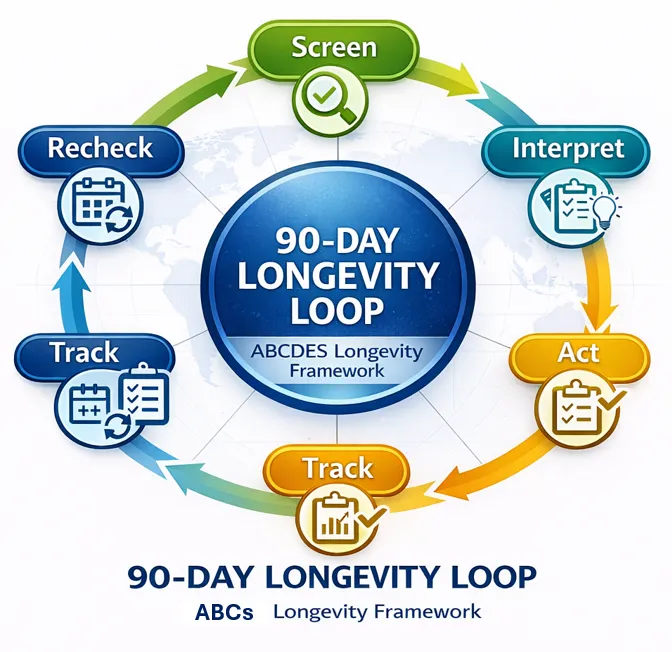
Do NOT stop checking and resetting every 90 days/3 months.
TAKE ACTION
The Reversal
Roadmap
01
Lifestyle & Weight Management
Research shows that losing 5–7% of your body weight significantly reduces the risk of progressing to type 2 diabetes. This is your primary window for intervention.
02
150 Minutes of Activity
Commit to 150 minutes of moderate movement per week. Consistent physical activity improves insulin sensitivity and directly lowers your A1C levels.
03
The 3-Month Recheck Cycle
Because red blood cells live for about 3 months, A1C reflects a 90-day average. Recheck every 3 months to track progress and reset your clinical baseline.
BEFORE YOUR NEXT VISIT
Clinical Clarity
Ask Your Clinician
Bring these crucial questions to your next appointment to ensure you understand your precise metabolic risk:
- What is my current A1C and what does it mean for my risk?
- Is my A1C trending up or down compared to last year?
- Do I qualify for the National Diabetes Prevention Program?
- Should I be checking my blood sugar at home?
- What lifestyle changes would have the most impact on my number?
Does A1C require fasting?
No. Unlike a fasting glucose test, the A1C test does not require you to fast. It can be drawn at any time of day.
Can A1C be inaccurate?
Yes, in some cases. Conditions that affect red blood cell lifespan - such as sickle cell disease, certain anemias, or recent blood transfusions - can give falsely low or high A1C results. Your clinician may order a different test if this applies to you.
What is the difference between A1C and fasting glucose?
Fasting glucose measures your blood sugar at one point in time. A1C reflects your average blood sugar over 2 to 3 months. Both tests have value, but A1C is generally preferred for screening and monitoring because it does not require fasting.
Can I lower my A1C without medication?
In many cases, yes - especially in the prediabetes range. Dietary changes, increased physical activity, weight loss, and improved sleep can all lower A1C. However, if your A1C is in the diabetes range, medication may be needed alongside lifestyle changes.

Initiative by:
Dr. Daniel L. Beckles, MD, PhD
Cardiac and Thoracic Surgeon
DKB Advantage, LLC
Medical Disclaimer: The ABCs Challenge, including information about A1C, Blood Pressure, Cholesterol, and Screenings, is for general educational and informational purposes only. It is not medical advice, does not provide diagnosis or treatment, and does not replace care from a licensed physician or qualified healthcare professional. Participation or use of this website does not create a clinician-patient relationship.
If you have symptoms, feel unwell, or have abnormal or concerning health numbers, seek medical attention immediately. Do not wait or delay care. For emergencies, call 911 or your local emergency number, go to the nearest emergency department, seek urgent care, or contact your physician’s office right away. Do not start, stop, or change medications or treatment based on this information without consulting your healthcare professional.
The ABCs Challenge, its organizers, sponsors, partners, affiliates, volunteers, and contributors are not responsible, to the fullest extent permitted by law, for any harm, injury, delay in care, neglect of care, missed diagnosis, adverse outcome, or damages arising from use of this information or failure to seek appropriate medical attention..
Data Sources: WHO (2023), PAHO/WHO (2022), CARPHA (2023), World Obesity Federation (2023), IARC (2016).
© 2026 Know Your ABCs Challenge. PRIVACY POLICY